The Habanero Project
How Far Can We Take It?
Refining the Habanero — VPI Albino, Hypo and Leopard — through intentional selection, thoughtful pairings and multiple generations of observation.
The Habanero is already a remarkable genetic combination. Bringing together VPI Albino, Hypo, and Leopard, it creates an opportunity for striking coloration, contrast, and pattern expression.
But producing the combination is only the beginning.
At Quantum Boas, we want to explore how far the Habanero phenotype can be refined through intentional selection, thoughtful pairings, and multiple generations of observation.
Rather than rushing to incorporate additional mutations, our focus is on understanding the range of expression already possible within Habanero genetics.
The animals behind the project
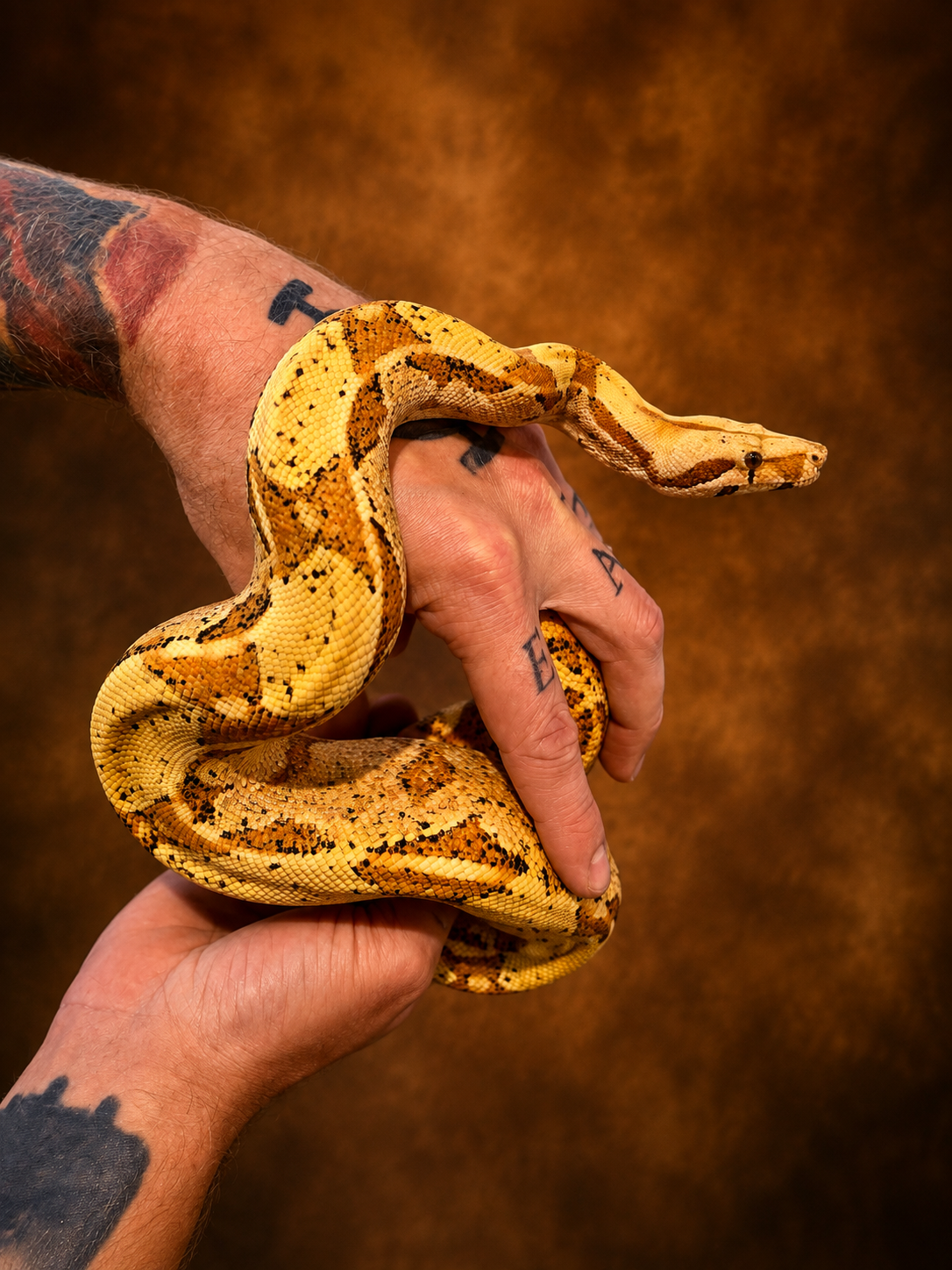
Killua comes from the Habanero breeding group established by ImperatorMorphs — VPI Sunglow, 100% het Leopard. The established Habanero direction is credited to their program; Quantum Boas did not originate the combination.
Habanero combines:
VPI Albino — recessive. Its own distinct T-negative albino line, unrelated to Kahl or JPC; the albino base the Habanero palette is built on.
Hypo — incomplete dominant. Reduces black pigment, lifting saturation and cleaning up the overall appearance.
Leopard — recessive. Rearranges pattern into broken saddles, striping and lateral speckling, adding visual complexity.
The Habanero is an inherited genetic combination — not a standalone mutation. The refinement this project pursues (intensity, cleanliness, consistency) is selective-expression work layered on top of that inheritance.
Credit for the established Habanero development belongs to ImperatorMorphs.
What we're selecting for
How intense can the color become? How clean can the contrast remain? How much variation exists in pattern and saturation? And which characteristics hold their quality as the animals mature?
Possible outcomes are documented as they happen in the project timeline. Nothing here is presented as a guaranteed genetic outcome.
Possibilities, not guarantees — outcomes are documented as they actually happen in the timeline below.
Where this project goes next
Only after meaningful refinement should complementary genetics be considered. The immediate priority is understanding and refining the Habanero itself.
Refinement Is the Project.
There's always another gene to add, another combination to pursue, and another direction a breeding project can take.
But we're interested in what happens when we resist the urge to immediately move on.
The Habanero already offers extraordinary potential for visual variation. We want to spend time understanding that potential before introducing new variables.
That means studying what our animals produce, following their development, comparing their phenotypes, and making deliberate decisions about which characteristics deserve to shape the next generation.
The goal isn't simply to produce more Habaneros.
It's to discover what makes an exceptional Habanero—and whether those characteristics can be developed and reproduced consistently.
What We're Selecting For
These are breeding objectives and observational criteria — not guaranteed genetic outcomes.
Color Saturation
Evaluating intensity, distribution, and consistency of red and orange coloration.
Contrast
Assessing separation between lighter and darker pattern elements.
Pattern Structure
Studying Leopard expression, saddles, lateral markings, and visual balance.
Cleanliness
Evaluating clarity of coloration and pattern boundaries.
Adult Retention
Tracking how desirable juvenile characteristics develop as animals mature.
Consistency Across Generations
Exploring whether desirable characteristics can be reproduced reliably.
A Multigenerational Program
Stage 1 — Establish the Foundation
Evaluate genetics and establish the phenotype direction.
Stage 2 — Explore Expression
Study the range of visible Habanero phenotypes and identify exceptional characteristics.
Stage 3 — Refine and Repeat
Make deliberate breeding selections designed to strengthen the desired expression.
Stage 4 — Evaluate the Results
Compare offspring over time and across generations.
Stage 5 — Consider What's Next
Only after meaningful refinement should complementary genetics be considered.
Beyond Habanero
Additional genetic directions may eventually be considered. Glacier development — involving VPI, Hypo, Leopard, and Anery Type 1 — is one separate, related long-term possibility.
The immediate priority is refining Habaneros — not adding new mutations.
Interested in Future Offspring?
Follow the progress of this project and register your interest in future offspring.
Follow Future Habanero Offspring“Genetics tell us what is possible. Selection determines where we take it.”